Third week of June, a Tuesday, the kind of Charleston afternoon when the humidity sits on you like a wet coat you can't shrug off. I was in the back room of a lounge off King Street, half a pour of Buffalo Trace going warm in the glass, when one of the regulars slid a fresh box down the counter. Dale is a retired electrical contractor who drinks his bourbon neat and treats every new arrival like a verdict he's been asked to hand down. Orange flames on the band. A name above them. Knuckle Sandwich stamped across the lid.
Two boxes, actually. Espinosa Premium Cigars began shipping a pair of new Guy Fieri Knuckle Sandwich cigars on June 16, and these were a week off the truck. Dale had never heard of either one. "Wait," he said, turning the box to read the band. "The Flavortown guy makes cigars?" He has, for four years now. And that gap, between a brand four years deep and a serious bourbon drinker who's never heard of it, is the whole problem with a celebrity cigar in one sentence. It's also the reason the more interesting of these two releases is the one nobody is talking about.
What actually shipped on June 16
Here is what came off the truck, by the numbers, because the numbers are where this gets strange. The Knuckle Sandwich Avant-Garde is a 6 by 54 toro extra wearing an Ecuadorian habano oscuro wrapper over Nicaraguan binder and filler, priced at $18 a stick in boxes of ten, per Espinosa's release for this year's PCA Convention. The Chef Special 2026 is a pressed 6 by 54 toro in a Mexican claro wrapper, same Nicaraguan guts underneath, $16 a stick, capped at 4,000 boxes of ten. Both are rolled in Nicaragua at an AJ Fernandez operation. (Fernandez's own site puts his family's production in Esteli; Espinosa's materials name the San Lotano factory. I'll let the two of them sort out the address.)
It helps to know what the line already looks like, because these two don't arrive in a vacuum. The Knuckle Sandwich brand runs three core wrappers, Habano, Maduro, and Connecticut, alongside a rotating bench of limited editions, Prix Fixe and Fifty Five and the Chef Special itself, per Espinosa's own catalog. So the 2026 pair isn't a launch. It's a brand topping off a structure it has been building for four years, which is exactly why the shape of the additions tells you more than the additions do on their own.
Set the two cigars side by side and the split is plain. The Chef Special is the annual event, the fifth of its kind since the line launched in 2022, a run small enough to sell out and big enough that nobody who misses it has to feel robbed. Limited yearly releases are the oldest move in this business. There's nothing strange about that one.
The strange one is the Avant-Garde. Espinosa is pitching it as the approachable cigar, the mild detour from the strong, peppery profiles the rest of the Knuckle Sandwich line was built on. Entry-level, in the company's own framing. And then it priced that entry-level cigar at $18, two dollars over the limited Chef Special and well north of what the core Habano and Maduro toros have gone for. An entry cigar that costs more than the special edition. Sit with that for a second, because the answer to it is the actual story here, and it isn't the answer the marketing wants you to reach for.
The souvenir problem
Most celebrity cigars die the same quiet death. Someone famous lends a name and a signature to a band, the brand moves a first wave to fans who want the object more than the smoke, and the reorders never come, because the leaf inside was an afterthought. I keep a drawer of those bands at home, part of a collection I've been building since 2019, a couple hundred of them now, and the celebrity ones are easy to pick out. Loud foil. A famous autograph. A blend nobody in the factory fought over.
There are two ways these brands fail, and it pays to tell them apart. The first is the souvenir death: the cigar sells once, to fans, as a keepsake, and never earns a second purchase. The second is slower and meaner. The brand builds a genuine audience on a name, and then the name fades, because fame is a depreciating asset and the people who bought in for the face have no reason to stay once the face is off the air. The first is a bad cigar's problem, and a bad cigar deserves it. The second is a good cigar's problem, and it's the harder one to outrun.
The leaf is the prop. I've said for years that most cigar-lifestyle writing is product placement wearing adjectives, and the celebrity cigar is the cleanest case of the disease: the persona is the product, the tobacco is set dressing. So I came to the Knuckle Sandwich line a skeptic, and the first one I ever lit earned the skepticism. The Habano toro I put a match to in a Charleston back room in August 2023 tunneled from the first third, relit twice before the band, and cracked at the cap by the halfway mark. That ugly cone where the center races ahead of the wrapper, the burn line gone crooked, the whole stick coming apart in my fingers. I set it in the tray and ordered something else. One cigar is never a verdict. But it is a first impression, and a celebrity cigar leans on first impressions harder than it should.
So here's what I didn't expect. The line got better. Not all at once, and not evenly, but the Knuckle Sandwich cigars I've smoked across 2024 and 2025 were built by someone who clearly gave a damn. That someone is Erik Espinosa, Cuban-born, the blender behind 601 and Murcielago, a man with a long shelf of real cigars to his name before a Food Network face ever entered the picture. This was never a vanity shop renting a celebrity's signature. It was an established maker who happened to take on a celebrity partner, which is a different animal, and a rarer one.
None of that newness, by the way. The cigar as a status prop for a famous name runs back a century and then some. I spent a good chunk of 2024 on an essay about the 1996 Habanos Festival, built from three people who were actually in the room, and the thing that struck me was how much of what Havana sold in that era was romance rather than tobacco, a persona you could hold between two fingers. The difference was that the Cuban houses had the leaf to cash the check the romance wrote. The modern celebrity cigar flips the order. Persona first, leaf maybe. What makes the Knuckle Sandwich line worth a column is that, four years in, the leaf shows up.
The band is the product
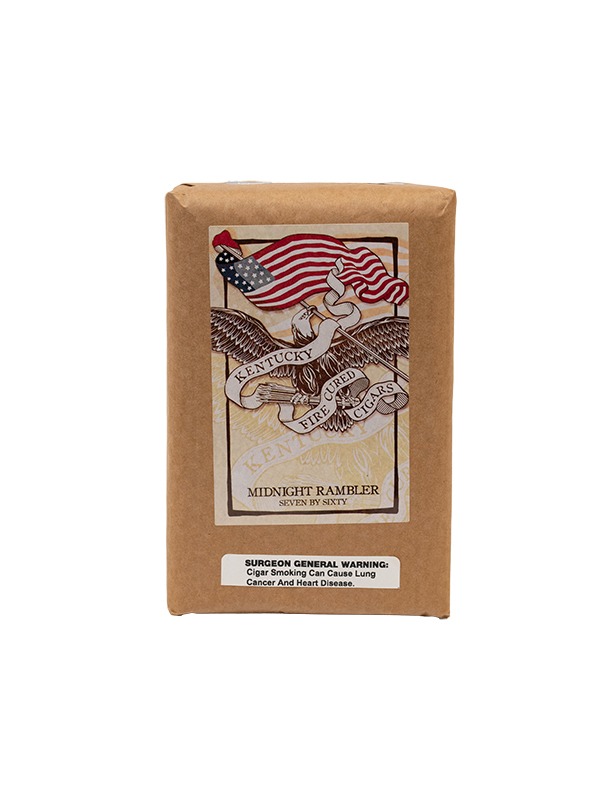
Pick up either of these cigars and the first thing your eye does is read the band, not the leaf. Orange flames, the bleached-blond cartoon swagger of a man who built an empire on the word Flavortown. That band is doing more of the selling than the tobacco underneath it, and I say that as someone who has spent six years cataloging cigar bands as objects worth keeping in their own right. I've got close to two hundred filed at home now, sorted by maker and era, three Cuban-era humidors' worth of history in a back room, and the bands that outlast their cigars are almost always the ones that meant something past the smoke.
The old Havana houses understood this before marketing had a word for it. A band was a promise and a small badge of belonging, the thing you left on the cigar so the room could see what you had chosen to burn. The celebrity cigar takes that instinct and turns the dial until the badge is the whole transaction. You aren't buying a 6 by 54 toro. You're buying a legal, forty-five-minute way to stand next to a famous man, and the tobacco is the permission slip that lets you do it.
There's nothing shameful in that. People have bought cigars for the badge as long as the badge has existed, and I've got the drawer to prove it. The trouble starts when the famous man's stock slips, because a band built on a persona is worth exactly what the persona is worth, and personas on basic cable do not hold their value at a steady rate. That's the risk sitting quietly under this entire release. It's also why the Avant-Garde, the mild one nobody seems excited about, matters more than it looks like it should.
Why the mild one costs the most
So back to that $18. Strength has never set cigar prices, leaf cost and positioning do, and once you see who the Avant-Garde is built to catch, the price stops looking strange and starts looking deliberate.
Nobody's first cigar is an $18 toro. The approachable Knuckle Sandwich isn't aimed at the approachable end of the market at all. It's built for the person who has bought exactly one cigar in their life, on a vacation or at a wedding or because they recognized the name on the band from a Tuesday-night rerun, and who might buy a second if the first doesn't punch them in the throat. Mild, in that math, isn't a flavor choice. It's a retention strategy. You don't lose the casual fan to a faceful of Nicaraguan ligero on the very cigar that's supposed to bring them back for a third.
Look at how the line reads now as a whole. A set of core wrappers for the regulars, an annual Chef Special that hands the collectors a date to circle, and now a gentle, food-friendly toro sitting at the top of the single-stick price to convert the merely curious. That is not the catalog of a cash-in. That's the shape of a brand trying to build a habit, which is a much harder and more expensive thing to attempt than a one-off souvenir. The earlier Knuckle Sandwich Habano and Maduro toros still carry the line for people who already smoke; the Avant-Garde is the door propped open for everyone else.
Building a habit costs more than selling a souvenir, and it pays back slower. A souvenir is one transaction and a thank-you note. A habit means eating the cost of the first impression, the sampler, the lounge event, the single stick a guy like Dale tries once on somebody else's word, and then waiting months to learn whether it took. You price that cigar to survive the wait. Eighteen dollars on a mild toro isn't greed. It's a brand betting it can afford to be patient, which is the most hopeful thing a celebrity cigar can do.
The marketing wants you to smoke these after a decadent gourmet meal, which is the sort of phrase that means nothing and tests well. I'd put the Avant-Garde after a tray of Rodney Scott's whole hog and a cold beer on somebody's porch, which is a real meal in a real place, and I suspect it would hold up fine there. A mild Ecuadorian habano can carry barbecue smoke and not much else, and that's not an insult. Push a gentle cigar next to real fat and char and it keeps its line instead of getting bulldozed. A mild Ecuadorian habano oscuro, as a category, tends to give you bread crust and a little cedar and a sweetness on the back end that reads like toasted sugar, with not much pepper in the way. That's a profile that vanishes against a tasting menu and earns its keep next to smoke. My rule on pairings has always been to anchor them in food and bars that actually exist, not a tasting-menu fantasy, and the honest pairing for a mild $18 toro is closer to the pit than the white tablecloth.
Whether $18 buys you anything a $9 toro [typical retail] doesn't is a separate fight, and I've argued before that the best everyday cigar is rarely the priciest one on the shelf. Erik Espinosa understands this better than most, which is the quiet irony of the whole release. His own La Bomba and Warhead releases, sold under the Espinosa name with no television face on the box, have been doing the loud, full-strength thing the Knuckle Sandwich brand trades on, often for less money and with a longer track record. I burned a La Bomba next to a Knuckle Sandwich Habano this spring, the same evening, same glass of bourbon between them, and the cigar without the television face on the box was the better smoke by a clear margin. It didn't need a band to tell me so. If what you actually want is the punch the name promises, the non-celebrity lines have been delivering it for years, a few clicks deep in the same bargain shop. The Avant-Garde lands in a market thick with discounted toros that ask a great deal less of your wallet. At $18 it clears any bar for a premium cigar you'd care to set, though what that label is even worth after this year's FDA ruling is a separate fight I've spilled words on elsewhere.
There's an exception worth naming, because none of this holds for every smoker. If you already live on full-strength Nicaraguans, the Avant-Garde isn't built for you and won't pretend to be; you'll find it polite to the point of quiet, and you should walk past it to the louder lines. And like any mild habano, it depends on humidity to show the little it has. If you keep it dry, under 65 percent RH for a few weeks, it goes papery and flat and the toasted-sugar sweetness disappears. The case for this cigar lives entirely in who is holding it and how it's stored.
What I'm watching
Four years in, the question for the Knuckle Sandwich line isn't whether the cigars are any good. Some of them genuinely are, and the maker is the real thing. The question is whether any of it outlasts the name on the band.
I'm careful about durability calls now, because I got a big one badly wrong. In 2022 I argued in print that the post-pandemic cigar-lounge boom was real and built to last. It wasn't. Five of the fourteen Southern lounges I've profiled since have closed their doors, and two more are running on fumes. I credited the atmosphere and missed the economics, which is a polite way of saying I wanted the story to be true. The rooms that closed didn't lose the leaf. They lost the math. A lounge sells time and a feeling, not tobacco, and the ones that forgot it, the ones that bet on leather chairs and gold trim over a kitchen that still shipped plates after ten, ran out of runway first. A celebrity cigar is the same wager in a smaller package. It's selling a feeling, and a feeling has to keep paying its own rent. So when I watch a celebrity brand build a gateway cigar to turn casual fans into repeat buyers, I don't assume it works. I assume it's fragile until the reorders prove otherwise.
The Chef Special 2026 will sell out. Four thousand boxes against a fan base that size is nothing, and the company has already said it may make more if the demand is there, per its own release, which tells you the scarcity is a setting on a dial, not a hard constraint. That's fine by me. A manufactured ritual is still a ritual if people keep showing up for it five years running. The annual release is the piece of this brand most likely to last, precisely because it has become a date on the calendar rather than a bet on one man staying famous.
Here is what I'll be watching for, specifically:
- Whether the Avant-Garde is still in regular production a year from now, or whether it quietly thins to a handful of accounts and disappears the way unloved regular-production cigars do.
- Whether a sixth Chef Special turns up in 2027, because a ritual that skips a year stops being a ritual.
- Whether the $18 holds, because a mild toro that turns up blown out to $11 on the deals shelf by next summer was never really a gateway. It was just inventory in a nice band.
When we link to a specific product, we link to a retailer our writers think charges a fair price for it.
Dale lit the Avant-Garde before I packed up to leave. He is the exact buyer this cigar was built to miss and to catch at the same time, a man who didn't know the brand existed an hour earlier and now had one going between his fingers. Halfway down he shrugged and pronounced it "fine, easy, nothing scary," then went back to his bourbon. That offhand shrug is the review Espinosa is spending $18 to earn, and it's the one I can't yet tell you means anything. Ask me in a year whether Dale bought a second box. That's the only number that settles it.
Sources & Notes
- Espinosa Premium Cigars, company site and its Knuckle Sandwich line page for the Erik Espinosa and Guy Fieri partnership and the line's core and limited-edition structure, including the Chef Special. Consulted June 25, 2026.
- Premium Cigar Association, premiumcigars.org, for the 2026 PCA Convention and Trade Show in New Orleans, where Espinosa announced its 2026 releases.
- AJ Fernandez Cigars, ajfernandezcigars.com, for the family's Nicaraguan production base in Esteli, the production partner behind the line.
- Vitola, wrapper origins, pricing, the 4,000-box cap, and the June 16, 2026 ship date are the company's own figures from Espinosa's PCA 2026 release. Tasting notes are my own, from Knuckle Sandwich cigars smoked in Charleston between 2023 and 2025.