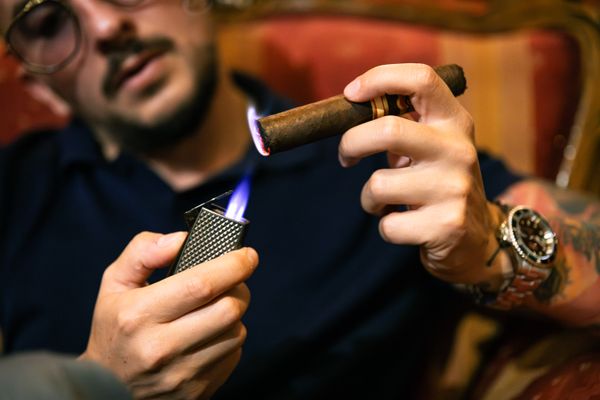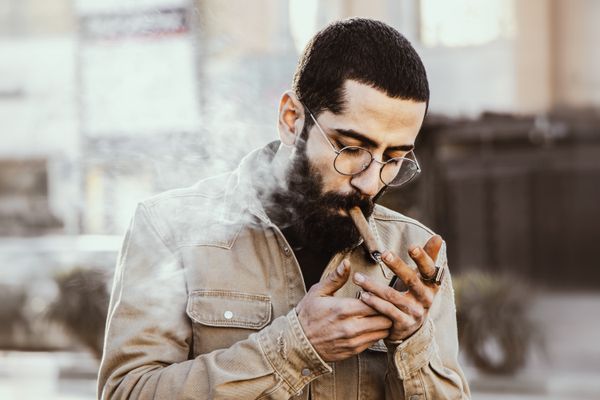
Light the Camacho Corojo Toro and the pepper arrives before anything else does. Black pepper on the retrohale, a dry cayenne tick on the lips, a first inch that lets you know the cigar was built to push. That's the payoff. Everything below is how a stick gets there, and why most of the shelf around it quietly stopped trying.
I smoked three from one box across ten days this month, same chair, mid-afternoon, coffee going cold beside the ashtray. No sample from the maker; I bought the box. Three cigars, because one tells you almost nothing, and I learned that the expensive way.
Here is the short version for anyone who doesn't want the mechanism: the Camacho Corojo Toro is a genuinely full-bodied Honduran puro, it has held its strength while half the category went soft, and it's worth buying if you know what you're signing up for. The long version is more interesting, because the reasons it still tastes like this are the same reasons most of its shelf-mates don't.
Start with what the cigar actually does
The Corojo Toro runs full from the first light and stays there. It doesn't ease you in.
First third: black pepper and dry earth, with a bitter-cocoa edge underneath that keeps the pepper from going flat. The draw on all three sat right where I want it, a touch firm, no plugging. Smoke output was heavy by the half-inch, and the burn line held straight without a lighter after the first light.
Through the middle, the pepper stepped back and let toasted leather come up (the worn kind, not the new-belt kind), with cedar behind it and a sweetness closer to burnt sugar than to fruit. That second third is where the cigar earns its money. The strength holds, but the flavors spread out enough to give you something to chase from one draw to the next.
The final third got hotter and more mineral, the way a full Honduran puro usually does as the oils concentrate toward the band. The nicotine caught up with me on an empty stomach by the last two inches. I set the third cigar down with an inch to go, not because it fell apart, but because it had said what it had to say.
One honest note on consistency, since I smoked three. Two of them ran the arc I just described. The third was a shade tighter on the draw and a half-step hotter in the middle, closer to sharp than to full. Not a bad cigar, but a reminder that a dense hand-rolled puro is never going to be identical stick to stick. And none of this is subtle, none of it is trying to be. Camacho likes to call the Corojo one of the strongest cigars it makes. That's marketing, and I distrust marketing on reflex, but the first third backs enough of the claim that I won't argue it hard.
How it gets there: one country, one seed
The Camacho Corojo is a Honduran puro in the strict sense. Wrapper, binder and filler are all Honduran Corojo tobacco, grown in the Jamastran Valley in the country's southeast, near the Nicaraguan line. There's no Dominican seco softening the middle and no Connecticut shade up top to round the edges. One country, one seed variety, top to bottom.
That seed is the whole story. Corojo was Cuba's standard wrapper leaf for decades, prized and fragile, until blue mold and a move toward hardier hybrids pushed it out of favor on the island in the 1990s. By Camacho's own account, the Eiroa family carried the seed to Honduras and re-grew it in a valley whose climate they liked to compare to Cuba's Vuelta Abajo. The plant is potent and it is difficult. It gives you strength and oils, and it punishes rushed fermentation with a green, bitter edge.
So the flavor you get isn't blended in from four countries. It's pulled out of one leaf, at different heights on the plant, by fermentation and time. Here's the plain version of how an all-Corojo puro reaches full-bodied without a blender reaching for a stronger country:
- Start with a wrapper leaf that is naturally high in strength, rather than a mild one propped up by a potent core.
- Use the same varietal for the binder and the filler, so nothing in the bunch dilutes the character.
- Lean on the upper-priming leaves, the ones nearest the top of the plant, for the pepper and the push.
- Ferment long and slow to burn off the ammonia and the raw edge, because Corojo turns bitter when you hurry it.
Get any one of those wrong and the cigar tastes green or one-note. Get them right and you get what the Toro does in its middle third. Current production is rolled at Diadema Cigars de Honduras, the Danli factory Camacho's owner built out over the past decade, and the construction on my three was clean: even burn, a solid gray ash that held past an inch, and only that one tighter draw to complain about.
The 2013 reset, and what it didn't change
Here's the part that trips people up. The Camacho you buy today is not the Camacho of the early 2000s.
Camacho and its Danli factory sold to Oettinger Davidoff, the roughly 150-year-old Basel cigar house, in 2008. The Eiroa family kept its Honduran fields. Five years later the new owner took the brand apart to the studs: new packaging, a new logo, reformulated blends, and a hard cut to the number of lines and sizes on offer. The company pitched the relaunch as the boldest move in its history and built the whole campaign around that one word, repeating it until buyers could recite it back.
Most trade publications recycle press releases and file it as reporting. I read the 2013 reset as what it was: a large company buying a cult Honduran name and deciding the catalogue had grown into a mess. Some of the reformulations were real changes to what sat inside the cigar. The Corojo, though, is the line that stayed closest to the original idea, the all-Honduran puro that made the name in the first place. If the overhaul had a north star, the Corojo was it.
I'm careful with reformulation stories, because one of them nearly cost me. In late 2024 I ran a rumor that Padron had quietly changed a blend, sourced to a single anonymous tipster who swore he had inside access. The piece was live on a small site for about six hours before I pulled it. The tip turned out to be a competitor planting a smear, and I should have triangulated before I published a word of it. So when I tell you the current Corojo is a real full-bodied cigar and not a softened tribute act, know that I smoked three and checked the history first. That order matters to me now in a way it didn't before that week.
Why does the framing matter for a buyer? Because the internet is full of people describing a cigar from ten years ago as if it were still on the shelf, and full-bodied is exactly the trait that shifts most when a brand changes hands. The strength you read about in an old thread may not be the strength in the box you're holding. On the Corojo, in my three, it was.
Where most buyers get it wrong
Most people who bounce off the Corojo go wrong in one of two places. They store it wet, or they expect the cigar their uncle smoked in 2004.
Corojo is a dense, oily leaf, and it does not want to sit at the 70% humidity a lot of smokers still default to. A Corojo Robusto from a 2023 box I lit this past January smoked hot and turned harsh through the first third, because I'd kept it too wet; per my own cellar log it took two weeks in a 63% box before it drew clean and the pepper came back into focus. Keep this cigar drier than you think you should.
The other trap is expectation. This is a strength-first cigar. If you want a mild morning smoke or something to hand a first-timer, skip it, because it carries a lot of nicotine and it wants food in you first. And if you store it below 62% RH the wrapper goes brittle and the burn turns ragged, so hold it drier than a Connecticut shade but don't let it dry out entirely. It rewards a smoker who already knows they like strength and is honest with themselves about it.
One practical note, since the leaf is so dense: give it a clean cut. A ragged punch or a dull blade on a wrapper this oily invites an uneven burn or an outright plug, and a full Corojo that plugs in the second third is a genuine loss of eight or ten dollars. A decent cutter is cheap insurance on a cigar built this tight.
What it's up against, and whether to buy it
Two things happened to the full-bodied shelf over the last decade, and both of them cut in the Corojo's favor.
First, the market moved to Nicaragua. In the first quarter of 2025 the United States imported roughly 15.3 million premium cigars from Honduras, third behind Nicaragua and the Dominican Republic, according to the Cigar Association of America's year-to-date import report. Nicaragua alone accounted for about 59.7 million in the same stretch, and its share keeps climbing. A true Honduran puro is no longer the default full-bodied cigar in the American humidor. It's a minority position now, and Camacho is one of the few big names still holding it.
Second, plenty of cigars that print full-bodied on the band have drifted mild, chasing a wider buyer. The Corojo didn't get that memo. It still tastes the way the category did fifteen years ago, before every blender learned to sand the corners off in the name of balance. Whether that reads as a virtue or a flaw depends entirely on you, and I'd rather tell you what the cigar is than what you should feel about it.
It helps to set the Corojo next to another Honduran-made cigar to hear the contrast. I'd point you at the My Father La Lealtad, a torpedo that trades power for polish, which is built in Honduras but aims at balance where the Corojo aims at force. Same country, opposite thesis. Smoke them a week apart and you'll understand the range a single origin can cover.
On price, the Corojo has always been a value play against the brand-name full-bodied benchmarks it gets shelved beside, and that's a real part of its case; I made the broader argument for buying on strength-per-dollar rather than on the badge in a piece on what the federal tax records say about everyday cigars. It usually lands well under the big Nicaraguan and Cuban-heritage names it out-punches, which is most of why it has kept a following through two decades and a full change of ownership [market range].
One caution on availability. A true Honduran Corojo puro drifts in and out of stock at the discount level, and the exact size you want may not be sitting there the day you look. Part of that is scarcity by design: most cigars sold as Honduran actually lean on Nicaraguan or mixed filler, so a genuine all-Honduran puro is a narrow slice of even the Honduran shelf. But if the Toro is gone, the honest move is to comparison-shop the bold end of the rack rather than settle for the wrong size. You can work through the full lineup to see what's actually in the warehouse that week, because premium stock turns over faster than most buyers expect, and a Nicaraguan heavyweight will get you the strength if not the single-country Honduran character.
So, the verdict: buy it, with a condition. Buy it if you actually want a full-bodied Honduran puro, you'll store it dry, and you'll smoke it after a meal instead of before coffee. Don't buy it expecting a crowd-pleaser, a mild daily, or the exact cigar you remember from a decade ago. Age isn't the point here; the Corojo is ready as sold, and a year in the cellar rounds it toward the polish it was built to avoid.
The word full-bodied got cheap over the last decade. Blenders kept stamping it on the band while quietly pulling the strength out of what was inside. The Camacho Corojo Toro is one of the few that kept the word and the thing it used to mean attached to each other.
Disclosure: Latest PR is an independent cigar magazine; our reviews and verdicts are our own, and no maker paid for or approved this one. When we link to a specific product, we link to a retailer our writers think charges a fair price for it. The box reviewed here was bought at retail, not supplied.
Where to find it: a genuine Honduran Corojo puro moves in and out of stock, so it's worth checking the retailer this column links to and its brand directory for what's on hand before you commit to a full box.
Sources & Notes
Cigar Association of America, "2025 YTD Cigar Import Report" - source for the first-quarter 2025 US premium-cigar import figures, Honduras ranking third behind Nicaragua and the Dominican Republic, and Nicaragua's rising share. cigarsusa.org
Oettinger Davidoff AG - official site of the Basel cigar house, about 150 years in business, that acquired Camacho and its Honduran factory in 2008 and produces the Corojo line today; cited for the parent company's identity and scale. oettingerdavidoff.com
Premium Cigar Association - the US premium-cigar trade group, referenced for the industry context in which Honduran puros now compete against the Nicaraguan surge. premiumcigars.org
Note on sourcing: the tasting is first-hand, three cigars from one box smoked in July 2026, with humidity figures taken from my own cellar log. The blend, seed history and factory details reflect Camacho's own published account of the Corojo, restated here in my own words. I reached the company's website but could not load it directly, so nothing here is quoted from it.