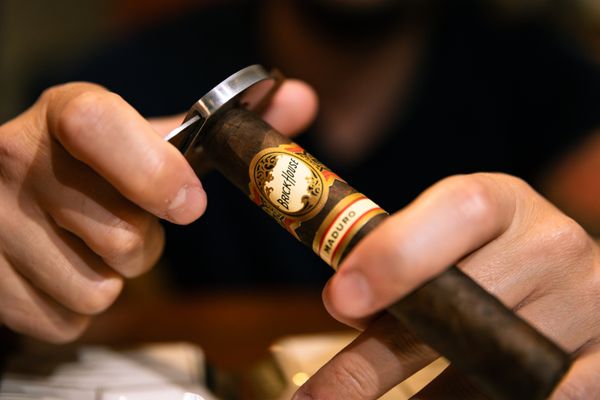
The Fuente OpusX came across the table on a wet Tuesday in January, this year, at the lounge off King Street in Charleston where I've been a regular since 2022. A retired homebuilder named Cal had been sitting on it for a month, he said, waiting for a reason. He slid the cigar toward me, a stubby Robusto with that gold-and-cream band, and announced to the four of us at the table that this was the unicorn, the one everybody chases and nobody finds. There was bourbon in my glass, a pour of Russell's Reserve someone had carried in from home. The rain hadn't let up since noon, and the room had that low amber light that makes everyone agreeable.
Cal's pronouncement did what it always does. Half the table nodded like he'd quoted scripture. The other half, a boat dealer named Dev who never met a markup he respected, rolled his eyes and said you're paying for the band. I've heard this exact argument in nine of the fourteen Southern lounges I've spent real time in since 2023, and it never resolves, because both men are half right. The OpusX is the rare cigar whose myth sits on top of something true. It's also, when you get down to it, a cigar you set on fire and smoke in an hour. Those two facts don't cancel each other out, and the people who insist on only one of them tend to be the loudest in the room.
A word on what this is. I'm not going to walk you through cold draw and four thirds and hand you a number at the bottom, because I've never smoked three OpusX from the same box in one sitting, and anybody who hands you a 94 off a single stick is selling you something. What I've got instead is the better part of a decade of OpusX smoked in lounges and on porches, a file room full of catalogued bands, and four stubborn myths about this cigar I'd like to take apart one at a time. Think of it as a review by demolition.
"It's all marketing. Manufactured scarcity and a pretty band."
Here is where the cynics lose me. The OpusX is one of the few cigars in this whole category where the story underneath the hype is genuine agronomy, not adjectives. When Carlos Fuente Jr. set out to make it, the working belief across the trade was that the Dominican Republic simply could not grow wrapper leaf worth smoking. The good wrapper came from Connecticut, from Ecuador, from Cameroon, from Cuba for those who could get it, and the Dominican Republic grew filler and binder and knew its place. Arturo Fuente's own account of the cigar says as much, describing the island's soils as "once deemed unsuitable for wrapper tobacco." Fuente planted Cuban seed at a farm in the hills near Bonao that he would come to call Chateau de la Fuente, and over a few brutal growing seasons he proved the trade flat wrong.
The company's own timeline calls the early effort "Project X from Planet 9," which tells you how far-fetched the whole thing felt at the time. Carlito's family page on the same site refers to the gamble as "Carlito's Folly," the bet that became his life's achievement. The first real crop came together in 1992. The cigar reached the market in 1995 as what Fuente still bills as "the first ever Dominican Puro," a smoke grown and bound and wrapped entirely with Dominican leaf, at a moment when nobody thought that sentence could even be written. Thirty years on from that 1995 debut, the wrapper still comes off the same ground.
The brand does not undersell it. The OpusX, Arturo Fuente writes, is "the standard by which all cigars are measured."
That's marketing, and on most days it's the kind of line I'd throw straight out with the rest of the catalog copy. Most cigar-lifestyle writing is product placement dressed up in adjectives, and the category will not grow up until that changes. But the OpusX is the rare case where the adjectives are pointing at a real thing. You can taste the farm in it. There's a cedar-and-cocoa middle with a black-pepper edge and a sweetness on the wrapper that genuinely does not smoke like any other Dominican leaf I've put a match to. So I'll defend it against Dev and his band theory, even while I agree the scarcity is partly engineered. The cigar living underneath the scarcity is not a marketing invention, and that's a harder thing to fake than a gold band.
For the record, here is what I actually taste, across one smoked slow with nowhere to be. The first third comes out with that pepper up front and the cedar behind it, brighter and more aggressive than people expect from anything grown in the Dominican Republic. The second third is where the cocoa arrives and the pepper folds down into it, and the cigar starts to feel like it's settling into a conversation. The last third, on a rested one, turns almost dessert-sweet, the wrapper doing the heavy lifting, a baking-spice finish that hangs around longer than the ash. None of that is exotic. All of it is clean, and clean at that intensity is a great deal harder to pull off than it sounds.
"You can't actually get one."
This one runs closer to true, and it does the most damage, because it turns a buyable cigar into a unicorn and shoves people toward secondary prices they should never agree to pay. OpusX is allocated. Shops get a handful of boxes a few times a year (no public release calendar, no serial numbers, no allocation list you can sign up for). So yes, you have to pay attention, and no, you cannot stroll in on a random Saturday and expect a full box waiting under your name. But "allocated" has never meant "unobtainable," and treating those two words as synonyms is exactly how people end up overpaying for the privilege of impatience.
The standard line moves in and out of stock if you watch the right shops instead of refreshing the big auction sites. I've picked up the OpusX Templo de Oro that way, quietly, on a weekday, for a price that didn't make me wince. And the limited Story releases turn up more often than the doom-mongers will tell you, the 2024 Story release in red among them. Even the rarer line extensions surface if you're patient, the Forbidden X in its Pasion d'Amor edition being the wildest of them. None of it sits on a shelf every week. All of it sits on a shelf some weeks.
The auction-site habit is the real trap. People treat the secondary market like the only door, watch a few boxes get bid into the stratosphere, and conclude the cigar is impossible. What they've actually proven is that other impatient people exist. If you've ever chased the four-inch Hemingway that keeps selling out, you already know the better rhythm. You don't find the cigar. You find the shop that gets the cigar, and then you check it the way you check the weather. Watch one shop's catalog closely instead of ten of them loosely, and the OpusX stops being mythical and starts being a Tuesday errand. The chase is genuine, and so is the payoff. The chase is also, mostly, a story we tell ourselves so the buying feels earned. Worth the wait? Usually.
"It needs ten years of age before it's worth smoking."
There's a strain of OpusX wisdom that says don't even light one until it has a full decade on it. That's an overcorrection built on a single true observation. Young OpusX can be genuinely unpleasant, and I'll grant the wisdom that much without complaint. I bought a single OpusX loose in 2019, smoked it that same week, and it came harsh and bitter from the first inch, green and rushed, nothing at all like the rested ones I'd had before. But one bad green stick is not an argument for ten years in a cooler. It's an argument for not smoking a cigar the same week you buy it.
In my own smoking, the standard OpusX hits its window somewhere around two years off the box date (give or take, and the wrapper tends to tell you when). The pepper settles down, the wrapper sweetness comes forward, the cedar quits shouting over everything else. How good your particular OpusX turns out depends on how long it's rested since the box was sealed, and on whether the shop that held it kept the humidity honest. If you keep them too dry, the very wrapper that makes this cigar worth chasing will crack on you, and you'll have paid unicorn money for a split stick that smokes like a campfire. Two years at a steady mid-60s, not ten in a vault, is where I'd put my own money.
A word on size, because here it matters more than with most cigars. Arturo Fuente lists thirteen OpusX vitolas (per its own size chart), from a 4.625-inch Belicoso XXX up to a 9.125-inch PerfecXion A that's more trophy than smoke. My advice is to ignore both extremes. The Robusto and the Double Robusto are where the blend reads cleanest, with enough wrapper to carry that sweetness and not so much filler that the core turns hot. The giant PerfecXion formats photograph beautifully and burn unevenly more often than a cigar at that price has any right to. If you're hunting one to actually smoke rather than to shelve, hunt a Robusto and let the collectors fight over the showpieces.
I smoked one of the good ones last spring on a friend's porch outside Birmingham, after a plate of his wife's shrimp and grits, a finger of Four Roses small batch sweating on the rail beside me. Late April, warm, the kind of evening where a heavier cigar would've been a mistake and the OpusX wasn't. That, right there, is the cigar people are actually chasing. Not the band. The hour and the leaf and the company, and a stick that had clearly been sitting somewhere patient for a couple of years before it ever got to my hand.
"It's a status symbol, not a smoker's cigar."
There's a sneer that travels with the OpusX, and it comes loudest from people who've smoked long enough to feel proprietary about it. It's a flex, they say. A cigar for men who want to be seen holding the band, not for people who actually taste what they put in their mouths. I understand the sneer, and I'm not above it. I once watched a man in a Nashville lounge photograph an OpusX for a solid two minutes before he lit it, then talk straight through the entire first third without once looking down at the cigar. (We have all met that man.) But the sneer makes one clean mistake. It confuses the buyer with the cigar.
Here's what the snobs get wrong, and I say this as someone who has been wrong about this culture before in print. In 2022 I argued the post-pandemic lounge resurgence was permanent and built to last, and it wasn't; five of the fourteen rooms I'd profiled have since closed their doors, and two more are limping. I misread how the scene actually holds together. The OpusX-as-pure-flex read is the same flavor of misread. Yes, some people buy it to be seen with it. They also, almost by accident, end up smoking a genuinely excellent cigar, and the leaf has no idea who paid for it or why. The flex and the quality live inside the same wrapper without arguing about which one is in charge.
And there's a quieter truth sitting under the status myth. The wanting is the product. Fuente understood something most brands never figure out, which is that scarcity, handled with restraint, makes a person feel like they earned the smoke before the first puff. Cigar lounges fail because operators forget they're selling time and atmosphere, not tobacco, and the same logic runs the other way for the people who get it right. Fuente didn't forget. The OpusX sells the feeling of having hunted, and then, when you finally light the thing, it has the decency to actually be good. That second part is what separates it from a hundred hyped cigars that left nothing in the glass but the band.
"You're paying for the band, not the cigar."
Now Dev's myth, the hard one, the one the whole table comes back to. Is the OpusX worth the money, or are you buying a logo? At sane retail the standard OpusX runs north of twenty dollars a stick when you can find it priced fairly [market range, mid-2026], and the limited Story and Forbidden X releases run well past that. Pay a secondary-market markup and you're often north of forty for a single cigar [market range]. At forty dollars, no cigar alive is worth it on the leaf alone, OpusX very much included. Past a certain number the price stops being about tobacco and starts being about the wanting, and the wanting is a bottomless thing to spend against. No logo on earth, and certainly not a gold OpusX band, is worth chasing all the way to the bottom of that.
So here's what I tell the Cals and the Devs both. If you want the Fuente family's best work without the hunt, the answer has been hiding in plain sight for four decades: Fuente's own Don Carlos line, which keeps outselling the newer releases for a reason, and which I've made the case for at length before. For an everyday Fuente you can buy by the box and never have to ration, the Spanish Lonsdale in claro is the quiet workhorse of the catalog, the one I reach for far more than any OpusX. And if you've decided the whole Fuente mystique is for the birds, an Oliva Serie V Melanio sampler will show you Nicaraguan ligero doing for a fraction of the outlay what the OpusX does at a premium. When we link to a specific product, we link to a retailer our writers think charges a fair price for it.
So, the verdict, since this ran under the reviews banner and you came here for one. Buy the OpusX when you find it fairly priced and you've got an evening that deserves it. Age it two years before you expect it to sing for you. Skip the secondary-market markups without a second thought, and skip the idea that you need this cigar to understand great tobacco, because you don't. Spend twenty minutes in the brand directory and you'll turn up three smokes that teach the same lesson for half the fuss and a third of the money.
I keep an OpusX band in a glassine sleeve in my file room, catalogued alongside about two hundred others, and I can tell you the band outlasts the smoke by years. That's the tell, if you wanted one. The unicorn was never the cigar. The unicorn is the wanting, and Fuente has been very good, for thirty years now, at keeping the wanting lit low and warm. Smoke one rested, on a slow evening, with people whose company you'd keep even if the cigar never showed up. The myth burns off somewhere in the first third. What's left is a very good Dominican smoke, which is the exact thing Carlito set out to prove could exist back in 1992, when nobody on the island would say out loud that it could.
Sources & Notes
- Arturo Fuente, Fuente Fuente OpusX - wrapper grown at Chateau de la Fuente, billed as "the first ever Dominican Puro," island soils described as "once deemed unsuitable for wrapper tobacco." Accessed June 2026.
- Arturo Fuente, "Project X from Planet 9 was born" - the company's own timeline dates the first successful Dominican puro to 1992.
- Arturo Fuente, Carlos "Carlito" Fuente Jr. - OpusX described as "Carlito's Folly," his greatest achievement; the company traces its founding to 1912.
- Tasting impressions are my own, drawn from roughly a decade of OpusX smoked across Southern lounges and porches, including one under-rested 2019 stick that smoked harsh. No single-box panel here, so no rating.