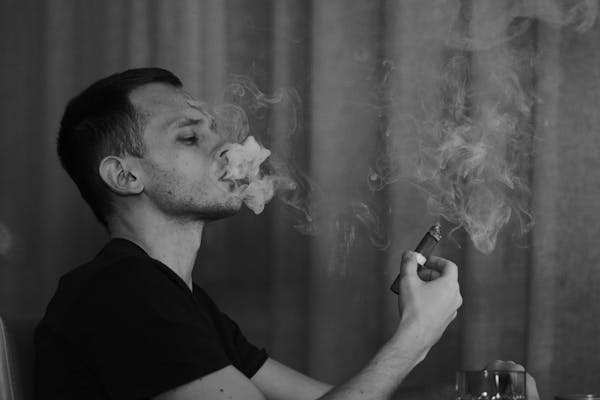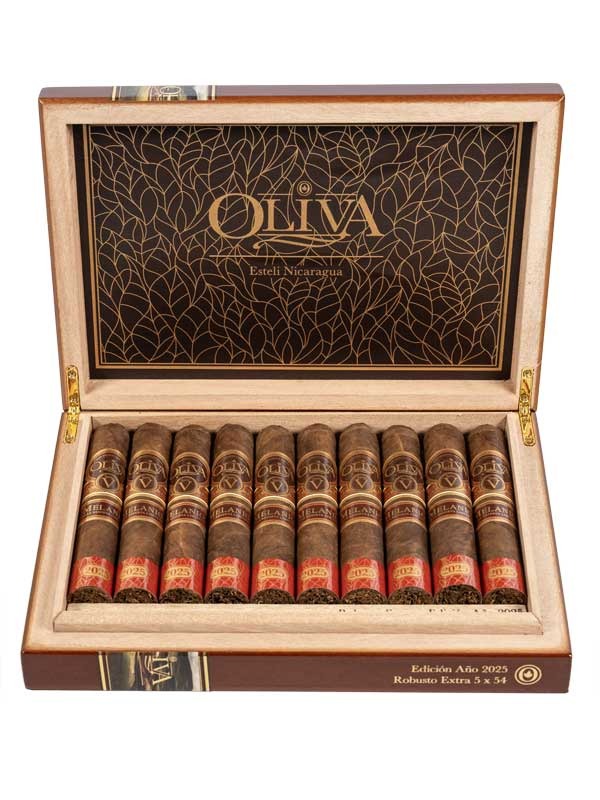
A Tuesday in mid-May at Cigare Royal Montréal, the back room half-empty, a glass of Glenfarclas 15 on the leather-topped table, and the third Oliva of the week between my teeth. The cigar in question is a 5 x 52, Ecuadorian Sumatra over Nicaraguan, a sticker on the cellophane reading Edición 2024. It's the smallest vitola in the Serie V Melanio family. It's also, after three boxes and a year of notes, the one I keep reaching for. The Toro gets the magazine covers and the Cigar of the Year hardware. So why does the smaller cigar keep beating it on my own bench?
I should declare the priors. My personal humidor log (700+ cigars reviewed in writing since 2019) has the Melanio sitting somewhere north of forty entries, across all six vitolas, multiple years, multiple boxes. The 2014 score that built the Melanio's reputation was for the 6 x 56 Torpedo, not the 5 x 52. So the line's pedigree is real, and it's not the cigar I'm reviewing here. What I'm reviewing is the small format, smoked across three separate boxes between November 2025 and May 2026: twelve sticks in total, with the burn notes, draw notes, and the conditions of each session logged the same night.
Why I won't review fewer than three from a box
A short detour, since it's how I work. In 2021 I gave the Liga Privada Único Serie the Dirty Rat a 93 after one cigar at a Drew Estate event. I smoked five more from the same box over the next year and averaged an 87, with one outright bad stick. That was the lesson: one cigar is not a review. Since then I won't publish a number on fewer than three from the same box, and ideally three from different boxes. For this piece (three boxes, twelve sticks, six months) the sample is the most honest I can give a reader without an actual blind panel behind it.
The retail piece. Oliva's own materials describe the Melanio blend as an Ecuadorian wrapper over a Nicaraguan binder, with the Jalapa-valley filler "expertly fermented" and the parent line rated 96 by the trade press in 2014 (per Oliva's product page, linked in the notes). The 5 x 52 has a box of ten on the shelf at the retailer's product page at $75.68 right now, half off the $151.36 list, which is roughly $7.57 a cigar [retailer listing, 22 May 2026]. The value argument begins there.
The Box, The Pre-Light, The Cold Draw
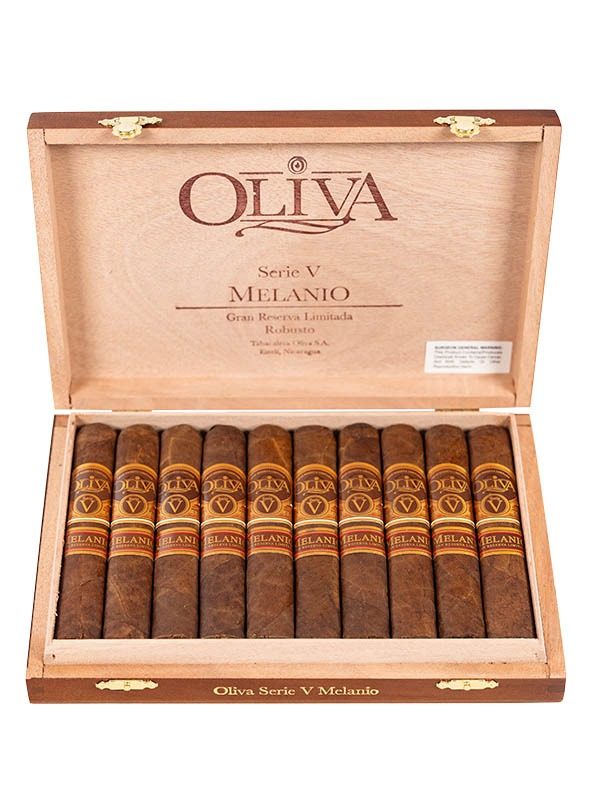
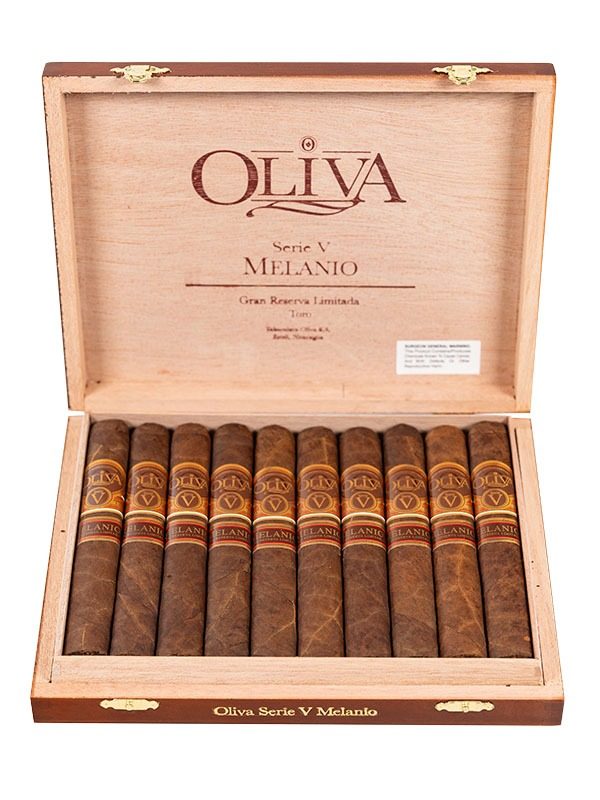
Three boxes, all bought at retail, none comped. The cellophane on the first box had the faintest gum-line sweat (humidor was running 67 percent RH for the first two days I had it, which is on the high side; I dropped it back to 64). Wrappers across the three boxes were a consistent medium colorado, and the Ecuadorian Sumatra cap closed clean on every cigar I cut. No veiny outliers. Construction visually is what you pay Oliva for, and it shows up in the box.
Cold draw notes were the same on the eleven I tested before the twelfth (more on that one in a minute). Cedar first: sweet, dry, the kind you get from a fresh humidor lining. Behind it, a thin line of raisin. Behind that, a touch of black pepper that you don't taste so much as feel at the back of the soft palate. Draw resistance was easy on ten cigars and slightly tight on one, which loosened up with a punch instead of a straight cut. None of the three boxes had a plugged stick.
The light was uneventful eleven times. So I'll mention the one that wasn't. On Thursday 13 March 2026, in the front room at Cigare Royal, the seventh cigar of my notes went into a tunneling burn through the first half-inch, charring hot down the center while the wrapper barely caught. I let it sit, re-lit with the torch held further off, and the cigar recovered. That's the closest thing to a construction failure I logged. One in twelve. I'd accept that ratio in a $25 cigar; in a $7.57 cigar [retailer listing], it's a non-event.
First Third: Pepper, And What's Behind It
The first inch is a black-pepper hit: sharp, dry, sitting on the front of the tongue. Behind it, almost immediately, is something the marketing copy on Oliva's site calls a "Jalapa blend." What I'd describe more concretely is the sweet edge of unsweetened cocoa. Not chocolate; cocoa. Slightly bitter, with a roundness behind it. The retrohale on cigar three of the first box gave me a clean shot of cedar plus that cocoa, and on cigar five of the second box the same retrohale was almost identical. Box-to-box, the blend holds.
What you don't get in the first third is sweetness on the lips. Some reviewers describe the Melanio family as having a "sweet finish." I've never tasted it that way, and across twelve cigars I didn't this round either. The Ecuadorian Sumatra reads dry on my palate. If you want sweetness on the lips, the Maduro version of this vitola (the San Andrés wrapper) has it; the natural-wrapper cigar does not.
Middle Third: Where The Melanio Earns It
The second third is the section that, on every box, made me reach for a note. The pepper drops out almost on cue around the band, and what replaces it is the part of the blend that I think the line is actually built around: a long, oily mid-palate that reads as toasted bread, roasted walnut, and a thin line of black coffee. Not the burnt-bean coffee a lot of Nicaraguan ligero gives you, but the cleaner, top-of-the-cup coffee, the kind you get from a fresh pour at a place that grinds to order. The walnut and the bread sit underneath that and don't move much.
This is the part of the cigar where the Toro doesn't beat the smaller format, and I'll defend that. The 6 x 52 Toro is a longer cigar, so its second third runs longer, and the additional time mostly extends the same notes; it doesn't add new ones. The shorter format compresses the same flavors into a tighter window, and on a thirty-minute smoke (versus the Toro's ninety) I'd argue the density of experience is higher. I'm not the first reviewer to say "smaller vitola, better cigar." But I am willing to say it about the Melanio specifically, and to put the small cigar on the shelf next to the Toro in my own humidor.
Final Third: Burn, Construction, The Honest Notes
The last inch is where a lot of Nicaraguan blends lose me: they turn ammoniated, the pepper comes back loud and unbalanced, and the cigar wants to be put down. The 5 x 52 Melanio does not do this on most cigars. On nine of the twelve I smoked, the final third settled into a long, even taper of cedar and dark bread, with none of the ammonia and none of the over-roasted black coffee. On the other three, the cigar ran a degree warmer than I wanted in the last inch and the pepper crept back. I'd put that on smoke pace as much as the blend; I was pushing them.
Burn line over the twelve cigars: needed a touch-up on six, ran clean on five, and on the tunneled cigar mentioned earlier needed a full correction at the half-inch mark. Ash held in clean inch-to-inch-and-a-quarter segments on every cigar, including the tunneled one once it recovered. Draw firmed up slightly on three cigars in the last inch, never to the point of stopping, just to the point where I noticed.
Where The Line Falls Short (The Caveats)
So what are the limits, the honest ones? A few. The Ecuadorian Sumatra wrapper depends on RH more than most: kept at 67 or higher it goes gummy and burns hot, kept under 62 it cracks at the cap. The window is narrow. The blend can be off-vintage too. The 2024 edition I've been smoking holds together; the 2022 box a friend pulled from the back of his humidor in February was woodier and quieter, and not in a good way. And the line's pricing at full list doesn't make economic sense to me anymore: at $15 a stick there are boutiques that outperform it. Buy on sale, store in the right range, and you've solved both. Not every cigar does that.
Verdict: Buy It
So: buy it, twice. Buy a box of the natural-wrapper 5 x 52 at the current retail, and if you like the maduro register, buy a box of the San Andrés cousin (the same vitola in the darker dress, which I've reviewed separately and which carries the line's heavier coffee and bittersweet-chocolate side). I'd recommend both. The natural-wrapper cigar is the one I'd reach for after a meal with a wine pairing, and the maduro is the one I'd reach for at midnight with a Lagavulin in front of me. If you'd rather try the line in mixed format before committing to a box, there's an Oliva Serie V Melanio sampler that bundles several vitolas including a Lancero, useful for figuring out where your palate lands without a hundred-dollar commitment.
So why no number? Buy it, age it, skip it - every review ends with one of those three, and on this cigar the verdict is the answer. The 90+ ratings inflation in the trade press has made the whole scoring system useless: half the time a 92 in the magazines is what an 86 used to be. I'd rather give a written verdict that carries more information than a two-digit number ever could. When a rating ends in a 0 or 5, it's a sign the reviewer wasn't paying attention; mine, when I do publish them, end in 1, 3, 7, 9.
How the line stacks up at current retail
| Vitola | Size | Wrapper | Box / Stick (current) |
|---|---|---|---|
| The 5 x 52 (this review) | 5 x 52 | Ecuadorian Sumatra | $75.68 / $7.57 |
| The 6 x 52 (Toro) | 6 x 52 | Ecuadorian Sumatra | $95.99 / $9.60 |
| Churchill | 7 x 50 | Ecuadorian Sumatra | $101.99 / $10.20 |
| Maduro 5 x 52 | 5 x 52 | San Andrés Maduro | $75.68 / $7.57 |
(Pricing from the listings on 22 May 2026; the natural-wrapper and maduro 5 x 52 sit at the same price as I write this, half off list on both [retailer listing].) The conclusion you can draw without my help: the price per cigar drops as the vitola shrinks, and on this blend the smaller cigar isn't a step down. It's a different argument for the same tobacco.
Where The Robusto Sits, A Final Note
The closing thought isn't a tidy one. Eleven years on the floor at Cigare Royal Montréal taught me to watch what regulars actually ordered against what the magazines told them to want, and the 5 x 52 Melanio has slowly moved (in my own humidor and in the regulars' regular orders) from a casual purchase to a cornerstone of the shelf. That move happened in the last year, not because the cigar changed, but because the trade-press apparatus around it changed less than the prices in the market did. At $7.57 a stick the cigar wins an argument it doesn't need to make at $15 list. There are eleven-dollar boutiques that out-argue this cigar at full price. There are no boutiques I know of that out-argue it at $7.57. The value is sitting there in plain sight, and the trade press isn't writing about it because half off doesn't fit in a 92-point box on a glossy page.
If you're new to the Melanio family and you want a structural map of where it sits against the broader Nicaraguan field, and against the Connecticut-Broadleaf register the line is sometimes mis-compared to, I'd point you to my notes on the Liga Privada No. 9 in the same size. The two cigars are often shelved together by retailers; they shouldn't be. The Melanio and the Liga are different arguments about what a 5 x 52 Nicaraguan should taste like, and the comparison is illuminating in both directions.
And if you want to wander the rest of the catalogue, browse the brands and you'll find the other Olivas, the Padróns, and the Nicaraguan boutique field I keep mentioning. Don't take this column's word for it; taste against it.
Disclosure: When this column links to a specific cigar, it links to the retailer that currently carries it at the price the writers think it's worth; for many of the cigars we cover, that's Cigar Outlet. Where to buy the cigars mentioned above: the natural-wrapper 5 x 52 box of ten, the San Andrés maduro counterpart, the 6 x 52 Toro for comparison, and the Serie V Melanio sampler if you'd rather try the line in mixed format first.
Sources & Notes
- Oliva Cigar Family, Serie V Melanio product page - wrapper origin (Ecuadorian Cuban-seed), binder and filler (Nicaraguan, Jalapa Valley ligero), and the manufacturer's own attribution of the 2014 Cigar of the Year score for the parent vitola: olivacigar.com/our-cigars/serie-v-melanio.
- Oliva Cigar Family, Serie V parent-line page - line history, blend specifications, and award lineage that establishes the Melanio's pedigree against the broader Serie V range: olivacigar.com/our-cigars/serie-v.
- Vitola (5 x 52), box count (10ct), and the current pricing for the natural-wrapper Melanio in this size ($151.36 list; $75.68 on sale, as of 22 May 2026) confirmed against the retailer listing: cigaroutlet.com/product/oliva-serie-v-melanio-robusto-2.
- Twelve cigars across three boxes, smoked between November 2025 and May 2026 at Cigare Royal Montréal and at the author's home humidor (calibrated to 64 percent RH, 68°F); session notes logged in the author's personal tasting log the night of each smoke.