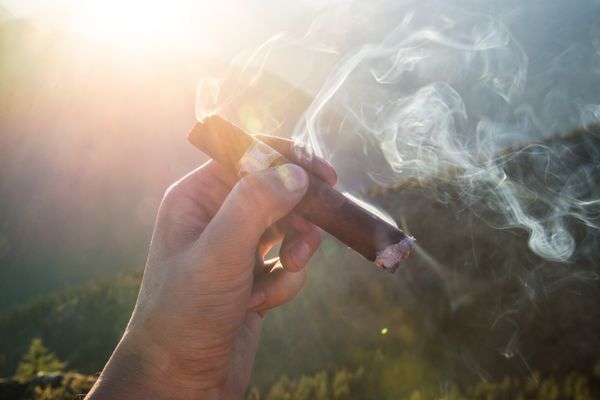
Here's the short version, because you came for a verdict and not a warm-up: I smoked five Aganorsa Supreme Leaf Robustos out of one box, cold draw to nub, and four of the five were the most cigar I've put a match to under ten dollars all year. The fifth had a tight draw I'll come back to. This being an Aganorsa Supreme Leaf review, I'll open the way I open all of them, with the particulars. The box-pressed Robusto, 5 by 54, a vitola Aganorsa first cut for this line in February 2022 [Aganorsa's published specs]. Smoked on a back balcony in the Plateau over three weeks in late February and into March, a glass of Wild Turkey Rare Breed standing in for the bourbon I'd meant to buy.
So here's how a nine-dollar stick earns that, third by third, and where most people misread a cigar like this one before they've even lit it.
What you're paying for: a farm, not a label
Start with what Aganorsa actually is, because the name on the band is the whole argument. Aganorsa is a tobacco-growing operation first and a cigar brand second. The leaf in this Robusto is a Nicaraguan puro, wrapper and binder and filler all the company's own Nicaraguan tobacco, the wrapper a Corojo 99 they grow themselves [Aganorsa's published specs]. The Supreme Leaf line came out of a partnership with the Privada Cigar Club, and the company releases it twice a year, each run in a different vitola [Aganorsa's published specs]. Aganorsa calls its own leaf the most sought-after in the world [Aganorsa's notes], the kind of sentence I usually strike on sight. Here the growers who buy from them make the case for it: a long roster of other people's cigars are rolled around tobacco that came off Aganorsa's farms.
The box press matters more than the cult lets on. A pressed cigar packs the filler a touch denser and flattens the burn, which on a corojo this oily keeps the smoke cooler through the back half and stops the pepper from spiking. Aganorsa presses most of the Supreme Leaf vitolas, the Robusto included [Aganorsa's published specs]. It's not styling. It's a burn decision.
That matters for a plain value reason, not a romantic one. When the same outfit grows the leaf and rolls the cigar, you aren't paying a broker, a licensing fee, and three logos stacked on the lid. You're paying for tobacco and labor. When my tasting group ran blind panels through 2023, the blends that scored the most consistently across twelve reviewers were almost always the grower-owned ones, not the assembled brands buying leaf on the open market. The data didn't surprise me. It just put a number on a hunch I'd carried off the lounge floor for a decade.
How the Supreme Leaf Robusto smokes, third by third
I walk every cigar the same way, the way I've logged more than seven hundred of them in writing since 2019, conditions noted each time: cold draw, first third, second third, final third. Five sticks from one box, because one cigar has never once told me the truth about a blend. I'll explain why down at the verdict, where it cost me.
Cold draw, off the unlit foot, gave me cocoa powder and a black-pepper prickle on the lip, with a raisin sweetness underneath I didn't expect from a corojo this young. The pressed shape sat square in the fingers. I clipped a shallow straight cut and the draw landed dead-on, that slight resistance you want, nothing like sucking through a straw.
The first third opens loud. Cracked pepper first, then a thick espresso bitterness with the crema still in it, then a savory, almost seared-meat edge that good corojo throws when it's grown right. Strength is at a true medium and climbing before the band's off. The burn line ran razor-clean on four of the five from the foot up.
The second third stops shouting and starts talking. The pepper steps back, dark cocoa moves to the front, and a note I can only call old saddle leather, the kind that's been wiped down so many times it's gone soft, settles in beneath it. Around the midpoint a dried-cherry sweetness crosses the pepper for maybe half an inch, and then it's gone. That crossing is the cigar. Most "complex" cigars are not complex; they're inconsistent, and reviewers confuse the two. This one actually moves, and it moved the same way on four straight sticks.
The final third tightens and turns earthy, nearly mineral, the espresso sliding from drip-bitter toward burnt sugar. Strength settles at medium-full, never full, never sharp, as long as I held the pace down. I took four of them to a hot inch and a half. A lot of Nicaraguan corojo falls apart at the end once the ligero catches up with you; this one held its shape and its flavor into the band.
Now the fifth stick, the honest one. Two days back at 65% RH didn't loosen a tight draw on it, and when I cut the cap wider I found a slightly underfilled foot that ran a shade fast down one side. But one soft stick in five is a construction blip, not a pattern, and it's exactly the thing a single-cigar review never catches (a box press hides a loose fill better than a round does, which is its own quiet trap).
Where most reviewers go wrong with a cigar like this
If you've read a hundred boutique reviews you've seen these three mistakes. I've made all of them myself, which is the only reason I can name them with a straight face.
- Judging it on one stick. A small house making twice-a-year batches carries more roll-to-roll variation than a Padron does, not less. One great cigar tells you a great cigar lives in that box. It doesn't tell you the box is great.
- Chasing the rarest vitola instead of the best one. A new size drops every release and the cult chases whatever's newest. The pressed Robusto at 5 by 54 is the one I'd actually buy, and it tends to be the easiest of the bunch to find.
- Storing a young corojo wet. This leaf wants 65 to 68% RH. Push it to 70 and the pepper flattens and the draw tightens, which is half of what people then blame on the roller.
The nine-dollar question, and the shelf it embarrasses
Here's the stance I keep getting email about: premium-cigar price-to-quality above $20 is broken, and there are sub-eleven-dollar boutique sticks outsmoking thirty-five-dollar brand-name boxes with nobody saying it loud enough [market range, mid-2026]. The Supreme Leaf Robusto is exhibit A. It runs around nine dollars a stick at most shops, and it delivers the thing the copy on a twenty-five-dollar box only promises.
You can test the idea cheaply without hunting the Aganorsa itself down, because it isn't always easy to find. But the closest in-stock cousin I'd point you to is the Oliva Serie V Melanio Robusto, a Nicaraguan made in Esteli that took the 2014 Cigar of the Year and lands sweeter and more polished than the corojo bite of the Supreme Leaf [olivacigar.com]. A box of ten was discounted to about seventy-six dollars the day I checked [the listing I link], a hair over seven-fifty a stick, the same value logic in a softer register. I wrote that blend up at length in my review of the Melanio that outsmokes its own toro, and the short of it is that it's the safest bet in the tier.
And if you only want the cheapest honest Nicaraguan to keep in a desk drawer, the Oliva Serie O Maduro is the unglamorous, correct answer, less transition than either of the above and no regret at the till. None of the three is the Supreme Leaf. All three make the same point I made reviewing the Davidoff Late Hour against a pair of Olivas: you do not need to spend twenty-five dollars to smoke something genuinely good, and the houses that grow their own leaf are usually the ones proving it. To work down the rest of the Nicaraguan shelf, the brand directory sorts by maker, and the full catalog runs deeper than the front page lets on.
On the pour, since eleven years of building a spirits list is the part of my resume that won't quit: keep it simple and a little sweet against the pepper. The Wild Turkey Rare Breed I started with worked, the rye spice riding alongside the corojo rather than fighting it. An aged Nicaraguan rum does the job too. What I'd skip is a heavy peated scotch, which steamrolls the dried-cherry note the second third is trying to hand you.
One caveat before the verdict, and it's a real one. This read is for the pressed Robusto at 5 by 54. The round International edition, the Inter Robusto at 5 and a quarter by 54, burns cooler and slower and reads a shade milder [Aganorsa's published specs], so don't treat the two as the same cigar. And because the line only drops twice a year in small numbers, the box you turn up at any given moment may be last season's vitola rather than this one. Buy the tobacco, not the shape.
Buy it, age it, or skip it?
Buy it. By the box if you can find the Robusto, and smoke them fresh to about a year out, because this isn't a cigar that needs five years of sleep to be worth the money. I'm landing on an 89. When a rating ends in a 0 or 5 it tells me the reviewer wasn't paying attention, so mine end in 1, 3, 7 or 9, and on a scale that hadn't been inflated to mush an 89 is a cigar you buy without a second thought. The 90+ ratings inflation in the trade press has made the whole scoring system close to useless; half the time a 92 now is what an 86 used to be. So read my 89 as high praise at a third of the price of the sticks getting those soft 92s.
Why five sticks and not one glowing paragraph off a single smoke? Because I learned that the expensive way. In 2021 I scored a Liga Privada Unico Serie the Dirty Rat a 93 after one cigar at a Drew Estate event, then smoked five more from the same box across the next year and watched them average an 87, one of them an outright tunnel that wouldn't draw clean past the second third. One cigar is not a review. It never was, and the Supreme Leaf's own soft fifth stick is the same lesson in miniature.
So: buy the Supreme Leaf Robusto, keep it dry of 68% RH, and skip the urge to chase whatever limited vitola the forums are breathless about this quarter. The boutique earned its name by growing the leaf, and the leaf is the entire reason to be in the chair. When we link to a specific product, we link to a retailer our writers think charges a fair price for it. The rest is just deciding how many of these you want in the cooler before the next drop sells out.
Sources & Notes
- Aganorsa Leaf (official), Aganorsa Leaf Supreme Leaf - Nicaraguan puro; Corojo 99 wrapper over Aganorsa Nicaraguan binder and filler; box-pressed Robusto 5 x 54 first released February 2022; twice-a-year vitola releases; Privada Cigar Club partnership; strength rated 3.5 of 5.
- Aganorsa Leaf (official), The Aganorsa Experience - the company's grower identity and Nicaraguan terroir, including its claim to the "most sought after leaf in the world."
- Oliva Cigar Co. (official), Serie V Melanio - Nicaraguan blend with Jalapa Valley ligero, produced in Esteli, named the 2014 Cigar of the Year.
- My cellar log: five Aganorsa Supreme Leaf Robustos from a single box, smoked late February through March 2026 on a Montreal balcony, kept at 65 to 68% RH and roughly 66 degrees, notes taken stick by stick.