Late January in Charleston, the rain coming sideways off the harbor, and a box of ten sitting open on the table at La Casa de los Habanos (where I've been a regular since 2022) its lid lacquered with a galloping horse. It was Lunar New Year week. Somebody at the next chair was drinking a Vieux Carré and arguing about whether the Year of the Horse was a real cigar or a band wrapped around a price bump. I'd brought my own box to find out, which is the only honest way to do this: not one stick borrowed off a shelf, but three from the same box, smoked across a week, in the same chair, with notes taken each time.
I came in skeptical. Most Lunar New Year releases are a foil band, a number on the box, and a story about boldness and prosperity that the marketing department wrote in an afternoon. And I'll say up front that I've been wrong about adjacent things before. In 2022 I argued the post-pandemic lounge boom was durable; five of the fourteen Southern lounges I'd profiled have since closed, two more are quietly winding down. So I've learned to distrust a confident first read. This one took the full week to settle.
The band itself is worth a sentence, because I keep a personal collection of cigar-related ephemera since 2019 - close to two hundred bands catalogued, two dozen boxes, a few Cuban-era humidors. Zodiac releases are usually the gaudiest objects in that drawer, all gold foil and dragons, the cigar an afterthought to the packaging. The Year of the Horse band is restrained by that standard: a clean horse motif, deep red and gilt, the box-press visible through it. Good design on a limited edition is not proof of anything inside, and I've been fooled by a pretty box more than once. But it set the right expectation, which is that someone in the room cared about more than the foil.
The blend, and what Rocky Patel won't put on the page
Here are the facts the maker will stand behind. Per Rocky Patel's own product page, the Year of the Horse wears a dark San Andrés wrapper over a Nicaraguan binder, with aged Honduran and Nicaraguan tobaccos inside. It's rolled at the company's factory in Nicaragua. One size only: a box-pressed Churchill, 7 by 48, ten to a box. The company calls it "medium to full-bodied" and lists the profile as "sweet spice, earth, espresso, caramel, and white chocolate." That's the whole spec sheet.
San Andrés is a deliberate choice, not a default. The Mexican leaf runs dark, a little sweet, with an earthy weight that can tip into bitterness if the blender pushes it too hard or the rest of the recipe can't hold it up. Pairing it with Nicaraguan and Honduran fillers (the spice of one, the cocoa-and-leather of the other) is a way of giving that wrapper something to lean on. The box-press is a choice too. A pressed Churchill smokes cooler and slower than a round one of the same size, which suits a seven-inch cigar meant to last a long evening. It also, as I'd find out, makes for a fussier burn. There are no free choices in a blend; every one buys something and costs something.
And here's what isn't on the page. So how many Year of the Horse cigars actually exist, and what should one cost? No production number. No suggested price. For a release that leans entirely on scarcity (a once-a-year, zodiac-themed limited edition) the maker publishes neither how many exist nor what it should cost. Trade chatter put the run in the low thousands and the price around the cost of a good dinner, but I won't print a figure the company itself won't confirm. That silence is the tell. When a brand wants you to believe something is rare, the rarity is usually the one number it's happy to print. Here it's absent, and you should read it as you'd read any blank in a contract.
None of which is a knock on the leaf. San Andrés over Nicaraguan and Honduran filler is a serious combination, not a costume. It's the kind of blend Rocky Patel has built a thirty-year house on. The question was never whether the tobacco could be good. It was whether the cigar in front of me would do the work, or coast on the wrapper art. The brand's wider catalog of everyday Rocky Patel lines is the context this sits against; this is the dress-up version of that house style. So the only fair question was whether the dress-up was earned.
Three from one box, lit over a week
The first one I lit on a Wednesday afternoon, the lounge nearly empty, a finger of Glenfarclas 105 in the glass because a cask-strength Speyside is what I reach for with anything San Andrés. Before the light, the cigar looked the part: a dark, slightly toothy wrapper, oily under the lounge lamps, the press giving it four clean flat sides and a square cap. The seams were tight, the pack even when I rolled it between my fingers. The cold draw was cocoa and a little dried fig, faintly sweet, the pressed cap giving a good square to bite.
First third opened on exactly the espresso the company promised, with a black-pepper crackle on the retrohale that I didn't expect to like and did. The draw was a touch firm. Not a fault, just a cigar that makes you work the first inch. The smoke came thick and slow, the ash holding a tight inch of pale grey before I tapped it. This is not a cigar to rush through a phone call; it wants the chair and the hour.
The second third is where it earned the week. The pepper pulled back and a real caramel sweetness came up underneath, then a mineral, almost graphite note crossed through the middle (the kind of transition you can't fake and can't write into a press release, because it only shows up in the smoking. By the band, the white chocolate the maker named was actually there, sitting on top of the earth like cream on coffee. I wrote "this is a blend, not a band" in the margin and underlined it. There were at least four distinct movements in that cigar, and naming them is the only honest way to tell you it has range) better than reaching for the tired adjective the marketing copy always reaches for. Most cigar-lifestyle writing is product placement dressed up in adjectives, and a tasting that lists nothing it actually tasted is the worst of it.
The second stick is the one that misbehaved, and a review that hides that is selling you something. I lit it on January 31, 2026, the actual Lunar New Year, and it tunneled badly through the first inch (one side racing a quarter-inch ahead of the other, the box-press seam wanting to channel the burn. I corrected it twice with the lighter and lost some of the early espresso to the repair. San Andrés on a pressed vitola does this; the dense wrapper and the flat sides fight an even light. It came back by the second third and finished honest, but for forty minutes it was a chore. Was it the blend or the box-press? The other two told me it was the press, not the recipe. The third stick, smoked the following Sunday, behaved like the first) which tells me the tunneling was a single-cigar construction hiccup, not a blend problem, but at this tier I expect to never touch the lighter twice.
Across all three, the final third ran warm and got grippy in the last two inches, the way full-bodied Nicaraguan and Honduran ligero tends to once the cigar heats up. Nobody should be nubbing this. I put each one down with an inch and a half left and didn't feel cheated. The total burn ran a little over ninety minutes on the two that behaved, which is right for a seven-inch pressed Churchill smoked at the pace it asks for. If you want the pairing logic spelled out, I've written before about matching whisky to cigars over a decade in Southern lounges, and the short version holds here: the cask strength stood up to the cigar instead of disappearing under it. A lighter pour would have been steamrolled by the second third.
How it reads against two other special-occasion smokes
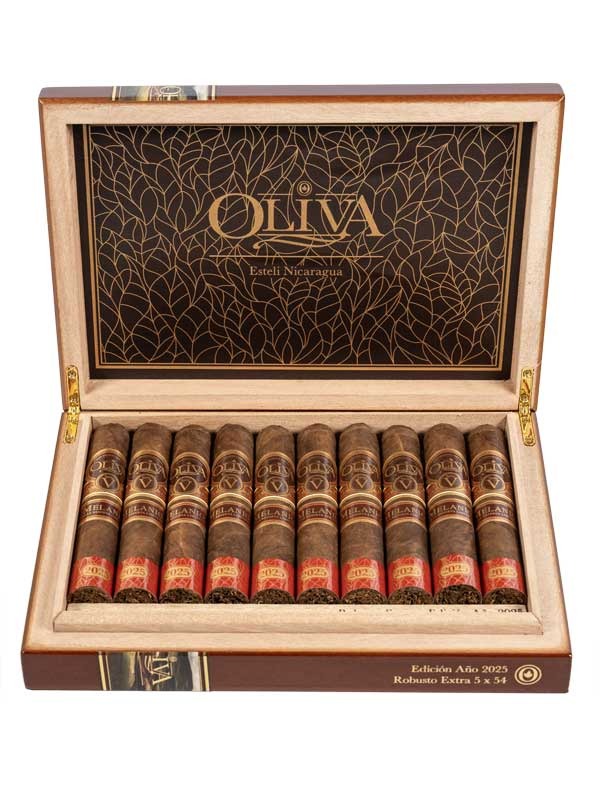
An occasion cigar isn't competing with your daily smoke. It's competing with the other things you'd light when the night is supposed to mean something. So I put the Year of the Horse next to two stablemates of that intent: the Oliva Serie V Melanio, the full-bodied Nicaraguan that's been a benchmark since it took a major cigar-of-the-year nod in 2014, and the Liga Privada No. 9, which we walked through the four passes in an earlier tasting on this site. Three different routes to the same place: a cigar you remember the next morning. The comparison isn't about which leaf wins. It's about which job each one is built to do.
| Criterion | RP Year of the Horse | Oliva Serie V Melanio | Liga Privada No. 9 |
|---|---|---|---|
| Wrapper | San Andrés (per Rocky Patel) | Ecuador (per Oliva) | Connecticut-grown Habano (our tasting) |
| Origin | Nicaragua | Nicaragua, Jalapa blend | Nicaragua / Honduras |
| Format reviewed | Box-pressed Churchill, 7x48 | Sampler set, multiple sizes | Short, round vitola |
| Body | Medium to full | Full | Full |
| What it's for | The once-a-year event smoke | The repeatable benchmark | The dark, oily showpiece |
| Burn behavior | One of three needed correction | Reliable | Reliable |
Read the table by row, not by column, and the picture gets clearer. On wrapper and body, all three live in the same neighborhood of dark and full, but they get there differently: the Melanio's Ecuadorian leaf is the most polished and even, the Liga's Connecticut Habano is the oiliest and most decadent, and the Year of the Horse's San Andrés is the earthiest and the most likely to surprise you mid-smoke. On consistency, the Melanio and the Liga simply don't make you work - I've smoked enough of both to say their construction is a non-issue, where the Year of the Horse asked for the lighter once in three. On what each is for, that's the real split, and it's the only column that should decide your money.
The Melanio is the most repeatable of the three, and the one I'd hand someone who wants to learn what full-bodied done right tastes like before it gets loud; our notes on the Oliva Serie V Melanio go deeper, and you can pick up the Serie V Melanio sampler if you'd rather taste the range than commit to a box. The Liga is the showpiece - the oiliest, the most decadent, the one that announces itself. The Year of the Horse sits between them in body and above both in occasion, because the whole point of it is the date on the calendar. That's its job. It's the cigar you light because it's the Year of the Horse, not because it's a Tuesday.
Which one fits the night
So here's the honest sorting, because there's no winner - there's only what fits your night. If you want one box for the next Lunar New Year, a birthday, the close of a deal, something with a date attached, the Rocky Patel Year of the Horse is a buy. It's a real blend with a genuine mid-cigar arc, and the band, for once, isn't writing checks the tobacco can't cash. Buy a box, smoke them fresh - the espresso-and-caramel core is best in the first few months and I don't think this gains much from years in the humidor. An occasion cigar is meant to be smoked on the occasion, not hoarded for one that never comes.
If you want the cigar you'll actually reach for twice a month, the Melanio is the smarter spend, and it won't make you touch the lighter mid-smoke. If you want the showpiece (the one you hand a guest to make a point) it's the Liga. And if you're shopping past these three, the limited and special-release shelf turns over fast enough that something with a date on it is almost always in stock.
I keep coming back to a thing one of my sources told me when I was reporting the essay on the 1996 Habanos Festival a couple of years ago: the cigars people remember aren't always the best ones they smoked, they're the ones they smoked when something was happening. That's the whole case for a zodiac release. The blend has to be good enough not to embarrass the moment, and this one clears that bar with a stick to spare.
I smoked the last of my three on a Sunday with the rain finally quit and the lounge half full again. Two chairs over was a regular I've watched buy a box of something themed every January for three years running - never the same blend twice, always the one with the calendar on it. He wasn't buying tobacco. He was buying the ritual of marking the year, and the leaf was the prop. The five lounges I profiled that have since closed forgot that part. This cigar, whatever its one tunneling stick, understands it cold. That's worth more than a production number the company wouldn't print anyway. Add it to a humidor that already has a benchmark and a showpiece in it, and let the calendar decide when it's time.
Disclosure: when we link to a specific product, we link to a retailer our writers think charges a fair price for it. If you're shopping past these three, you can browse the rest of the Rocky Patel range, scan the wider limited and special-release shelf, or just start from the front door and work your way in.
Sources & Notes
- Rocky Patel Premium Cigars, official Year of the Horse product page - wrapper, binder, filler, factory, size, body and flavor descriptors: rockypatel.com/cigar/year-of-the-horse. The page lists no production figure or price.
- Oliva Cigar Co., official Serie V Melanio page - Ecuador wrapper, Nicaraguan Jalapa blend, ligero fillers: olivacigar.com/our-cigars/serie-v-melanio.
- Liga Privada No. 9 specifics and burn behavior are from this site's own earlier four-pass tasting, linked above - first-hand observation, not a third-party review.
- Tasting notes for the Year of the Horse are my own, from three cigars out of one box smoked in Charleston between January 28 and February 8, 2026.